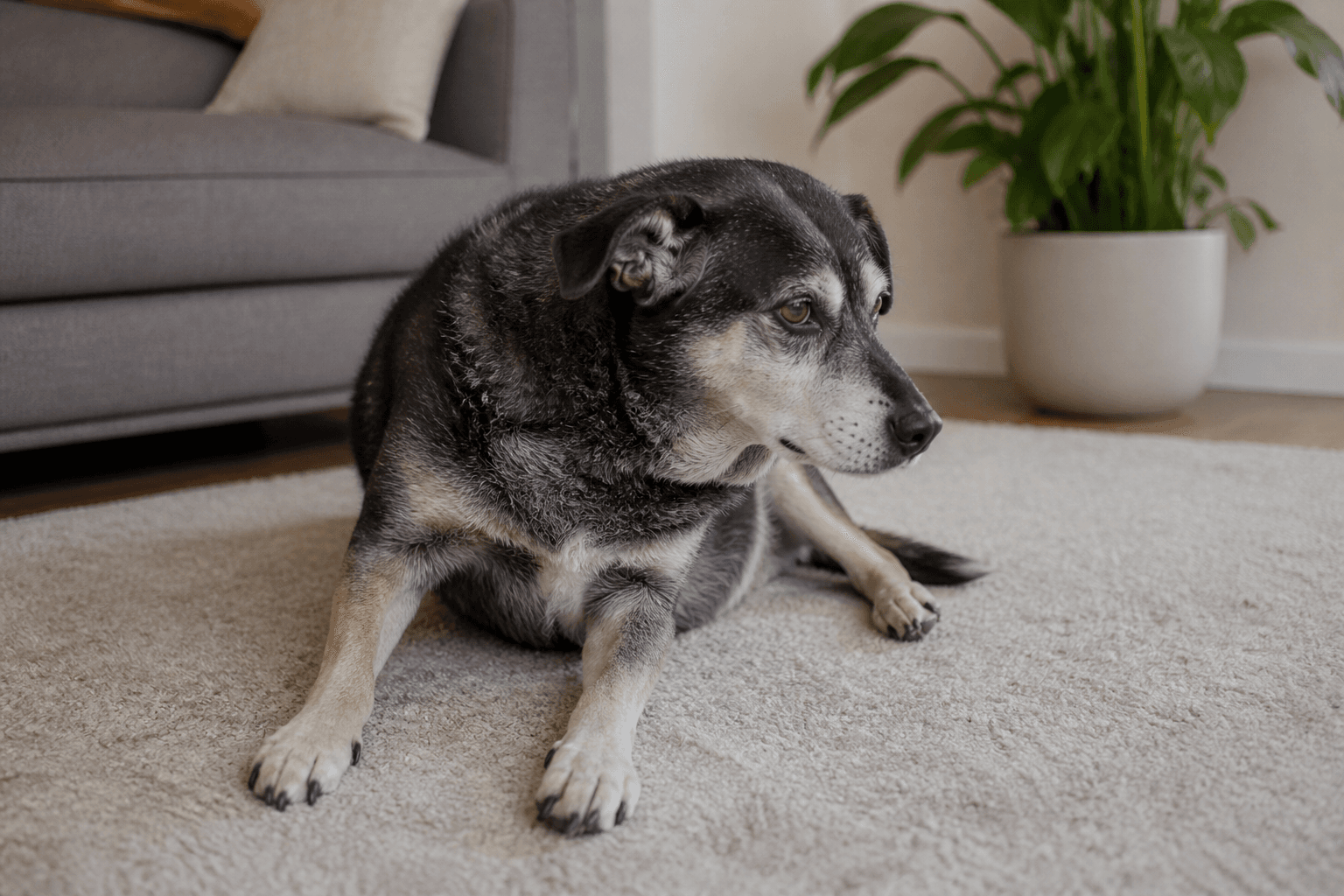
Cão idoso deitado no chão hesitando em se levantar

Image credit: Acervo pessoal: DogWise

Health8 min readPublished on August 27, 2026

How to know if your dog is in pain: signs that the owner often ignores

You look at the dog and think, “He’s not moaning, so he must be fine.” The next day, he takes a long time to get on the couch. Then, he starts sleeping in another corner. Then add the enthusiasm of the tour. Nothing “big” happened—and yet something changed.

This is exactly where many tutors get lost. Dogs don't explain pain with words. Many hide discomfort. Loud moaning, obvious limping or continuous crying exist, but are not the rule. The right question is not “is he screaming in pain?” It's: what changed in his way of living his day?

This text is educational and does not replace evaluation, examinations or guidance from a veterinarian. If severe pain, trauma, difficulty breathing or collapse is suspected, seek care without waiting “another day to see”.

The direct answer

How do you know if your dog is in pain? At home, you compare the dog with himself: posture, gait, appetite, sleep, mood, desire to play and reactions to touch. Persistent change — even discreet — deserves recording and, when in doubt, consultation.

It is not possible to diagnose using a cell phone. You can tell that something is not normal and bring useful facts to the clinic. A companion DogWise article on signs that your dog may be in pain delves into what to do next; here the focus is on what the tutor usually ignores.

The American Veterinary Medical Association reinforces, in material aimed at owners and clinics, that owners often have difficulty recognizing discomfort — and that changes in behavior are part of the conversation about acute or chronic pain.

Why pain “goes unnoticed”

Three common reasons:

  1. The dog masks. In a family environment, many continue to eat and shake. The discomfort appears in details.
  2. Change is slow. Chronic pain (e.g., joint) rises little by little. The tutor’s brain adapts: “it’s always been like this”.
  3. We translate it wrong. “He’s old”, “he’s stubborn”, “he’s lazy”, “he’s angry” — labels that hide pain.

The point is not to feel guilty. It's training your eyes.

Discreet signs that the owner tends to ignore

Use this list as a radar, not a diagnosis.

1. Hesitation to move

He takes a while to get up, avoids jumping into the car, chooses the lowest step, refuses the sofa that was previously his favorite. It feels like “tiredness”. It's often calculation: movement hurts.

2. Different posture

Back arched, weight only on three legs, head low, abdomen “retracted”, stiffness when sitting or lying down. Take a profile photo on a good day and compare it later — the difference is obvious.

3. Mood changes for no clear reason

Becomes quieter, avoids visitors, growls when touched on the back or paw, or is “irritated” without provocation. Pain can shorten patience. Don't just interpret it as bad behavior.

4. New sleep and resting place

Change songs, climb on furniture less, sleep more during the day, wake up restless at night. Sometimes it's routine; Sometimes it's looking for a less painful position.

5. Licking or excessive attention to one spot

Licks paw, flank or joint for long periods. It could be skin, boredom or discomfort. If it is at night and repeats, the text about dog that licks its paws at night helps to organize what to observe — without replacing an exam.

6. Appetite and “desire” changing

Eats more slowly, leaves food, avoids chewing hard snacks, or appears hungry but stops halfway through. Pain in the mouth, neck or body can reduce the pleasure of eating.

7. Shorter tour “out of nowhere”

Stop pushing with excitement and start dragging your pace, sitting in the middle of the path or asking to come back early. Heat and age factor in; pain too.

8. Pee and stool with straining or new accidents

Difficulty squatting, slow elimination, escapes in a trained dog. It can be urinary, neurological, orthopedic or pain when positioning. If thirst and peeing have increased together, see also [dog that drinks a lot of water and pees a lot](/pt/cao-bebe-mita-agua-e-faz-a- lot-pee).

9. Breathing and expression

Panting at rest, “off” look, ears back frequently, facial tension. It's not theater: it's body language.

10. Tremor, tension when touched or refusal of affection in a specific area

If he moves his hand away from his neck, spine or paw, respect it and take note. Don't force an in-depth home exam.
Which is NOT proof that “everything is fine”

  • Continue eating
  • Keep wagging your tail
  • Play “a little”
  • Don't moan
  • Getting better after a human analgesic (this is dangerous and does not confirm anything safely)

Eating and shaking do not cancel out pain. These are signs of bonding and routine, not the absence of discomfort.

Cão em pé com postura rígida e dorso arqueado em ambiente doméstico
Image credit: Acervo pessoal: DogWise

How to observe at home without inventing an exam

Keep a short diary for two to three days if the dog is stable:

  • time when you noticed the change;
  • what he avoided (sofa, stairs, car, toy);
  • if you limp on smooth ground or just after walking;
  • if it gets worse in the cold or when you wake up;
  • appetite, vomit, feces, urine;
  • 10–20 second videos: walking, climbing, lying down, getting up.

Film in the same hallway, with good light. The veterinarian sees what the memory edits.

Don't do:

  • give human medicine (paracetamol, ibuprofen, dipyrone “because it always works”, anti-inflammatory drugs);
  • massage a painful area vigorously;
  • force stretching or “flexion test”;
  • wait for the pain to become severe to make an appointment.

When to make an appointment — and when it’s urgent

Mark in the short term if the change lasts for days, gradually gets worse or the dog is “no longer the same”, even without whining.

Anticipate if there is:

  • lameness (limp) that does not go away;
  • touch sensitivity;
  • clear power outage;
  • loss of appetite;
  • difficulty climbing or squatting;
  • elderly with sudden change in mood or mobility.

Urgent assistance if you notice:

  • scream when moving, trauma, fall, suspected run over;
  • inability to support the paw or stand up;
  • hard, swollen or very sensitive abdomen;
  • repeated vomiting, very pale or bluish gums;
  • difficulty breathing;
  • convulsion, disorientation, collapse;
  • intense effort to urinate with little or no pee;
  • bleeding or deep wound.

When in doubt between “tomorrow” and “today”, choose the path that protects the animal.

Elderly, puppy and “strong” dog: different readings

  • Elderly: “age thing” does not end the case. Age increases the risk of problems; does not authorize ignoring pain. AVMA's guidance on senior pets reminds us that aging is not an illness — and that check-ups help find problems early.
  • Puppy: pain can come from trauma from play, growth or infection. Abrupt change deserves evaluation.
  • “Tough” or working dog: many show even less. Compare performance and mood, not just voice volume.
Mãos filmando com celular a caminhada lenta de um cão no corredor
Image credit: Acervo pessoal: DogWise

What to bring to the appointment

Take videos, a list of medicines and supplements, food changes, approximate start date and what makes things worse or better. Say specific phrases: “he has been avoiding the sofa for five days”, “he limps on the kitchen floor”, “he only growls on his right hip”.

The veterinarian may examine, order imaging, blood or other tests. The plan depends on the find — not on an internet label.

What to do while you wait (without dealing on your own)

  • Avoid unnecessary jumps and stairs.
  • Non-slip flooring helps.
  • Shorter, more frequent walks if he still wants to walk without obvious distress.
  • Water and rest easy to reach.
  • Calm environment; no scolding for “laziness”.

This reduces effort. Does not replace diagnosis or prescribed painkillers.

Frequently asked questions

Does a dog in pain always moan?

No. Many become quiet, rigid or just change their routine. The absence of groaning does not prove comfort.

Can I give human pain medicine?

No. Several human medications are toxic to dogs. Only use what your veterinarian recommends, in the right dose and time frame.

If he is still playing, could he be in pain?

Yes. Playing less, stopping in the middle or avoiding certain movements is already information. Pain doesn't have to be total to matter.

Is chronic pain only in old dogs?

It is more common with age, but young dogs can also have an injury, infection, dental problem or other causes. Age is not the only filter.

How to differentiate pain from fear or stress?

Sometimes they mix. Fear usually has a trigger (thunder, visitors, street). Pain usually accompanies movement, touching an area, or persistent change without a clear trigger. When in doubt, consult your veterinarian — including to avoid punishing a dog that is defending itself from painful touch.

Do I really need a video?

It helps a lot. In the office, the dog can “behave” and hide the limp. The home video shows the actual pattern.

Conclusion

Knowing if the dog is in pain starts with noticing what has changed, not waiting for a scream. Hesitation, new posture, short temper, licking, shorter walks and refusal of affection in one spot are warnings that the owner usually labels as laziness or age.

Write it down, film it, don't medicate on your own and schedule an evaluation when the change persists. Pain treated early is often easier to manage than pain ignored for months. Taking good care is paying attention to silence — and taking action when your dog's pattern is no longer the same as usual.