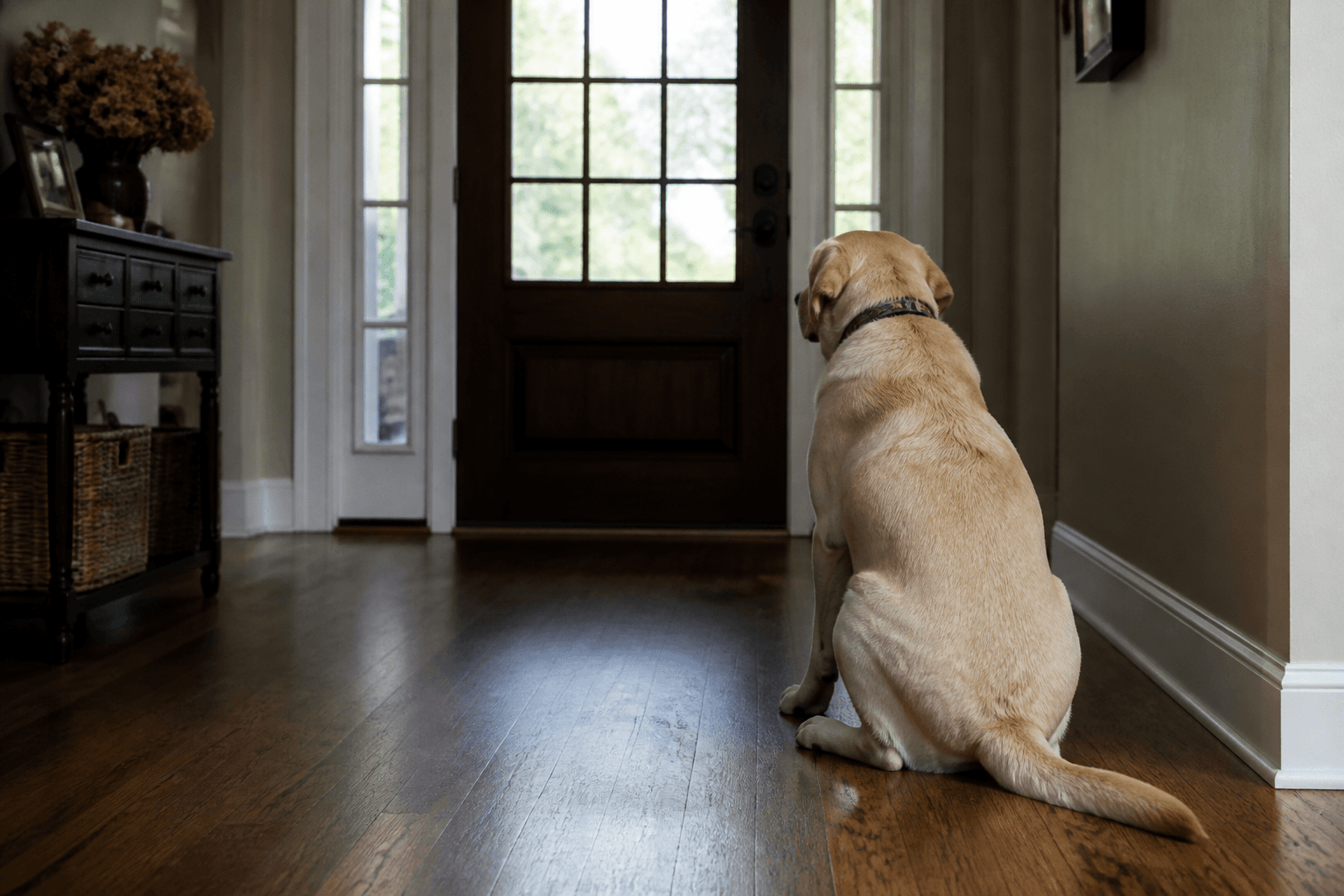
Cão observando a porta depois que o tutor sai de casa

Image credit: Acervo pessoal: DogWise

Behavior11 min readPublished on August 17, 2026

Dog only barks when I leave the house: anxiety or habit?

You close the door and the dog starts barking. When he is at home, he seems calm; therefore, neighbors complaining or a recording may be the first evidence of the problem. Calling everything separation anxiety is as inaccurate as treating all barking as “trickery.” The sound may be related to fear of being alone, frustration at losing access to the tutor, noises in the hallway, movement at the window or a learned sequence.

The difference appears in the set of signals, the moment they begin and the ability to recover. A dog that barks at the elevator and then sleeps is in a different situation than one that vocalizes without pause, tries to escape, salivates and doesn't touch its food. Before choosing a technique, you need to find out what happens afterward when no one is watching.

The camera is the beginning of the investigation

Position a camera or cell phone safely, with a view of the area where the dog usually stays. Record audio and images from a few minutes before departure until at least the period when complaints typically occur. Do this over more than one day, without creating situations far beyond what he already faces.

Register:

  • how many seconds or minutes after leaving the barking begins;
  • what happened immediately before: key, shoe, door, elevator or noise;
  • posture, movement, breathing, salivation and escape attempts;
  • whether he accepts food or toys;
  • duration of episodes and silent intervals;
  • the place you look at while barking;
  • time needed to lie down or resume normal activity.

Only audio can confirm noise, but does not show fear, window orientation, or escape behavior. The image also reveals whether another dog in the house initiates the reaction.

Respect privacy and site rules when positioning equipment. The recording should focus on the home environment, not the private areas of others.

Anxiety, alarm, frustration or habit: useful clues

Suffering related to separation

It can start at the exit signs or in the first few minutes of absence. In addition to barking, howling, repetitive pacing, panting without heat or exercise, salivation, elimination, destruction near doors and windows, and refusal of food may occur. Not all dogs exhibit all signs, and isolated destruction does not seal the diagnosis.

Some look good with anyone; others suffer when a specific guardian leaves; others cannot tolerate being without human company. This difference changes the plan and should be reported to your veterinarian or behaviorist.

Alert to sounds and movements

The dog can rest between events and get up when he hears an elevator, gate, deliveries or other animals. In houses with windows overlooking the street, visual movement keeps watch. The bark points to the source and ends when it passes. In this case, environmental management plays an important role.

Frustration due to barriers

Some dogs see their owner leave and try to follow him, but then recover. They may bark at the door, scratch for a short period and then look for another activity. Frustration still deserves care; forcing long absences can make it worse.

Reinforced behavior

If the owner returns while the dog is barking, talks through the camera or returns to scold him, the barking may produce attention or reopening of the door. This does not mean that the initial cause was “manipulation”. Learning and emotion coexist. The solution involves teaching alternative behavior and working absences below the limit.

Unmet needs

Lack of opportunity to urinate, accumulated energy, hunger, heat, pain and discomfort also increase vocalization. A walk before leaving is not a universal cure; It needs to be suitable for the dog and offer time to sniff and eliminate without exhaustion.

What to do before leaving

Create a routine that is predictable and compatible with the individual. Ensure physiological needs, water, safe temperature and resting place. Do the activity at a time that allows the dog to slow down before leaving. Intense play and immediate departure can make him more activated.

Close curtains or use film when visual stimuli are triggers, preserving adequate ventilation and light. Move the resting place away from the hallway door. A constant low noise can mask sounds, as long as it is not startling or loud.

Offer a safe food item only if the dog already uses it well under supervision and does not destroy parts. Count calories. The camera will show if he actually uses the item. A dog who abandons you as soon as the door closes may be over his emotional threshold; leaving more food doesn't solve this.

Don't say long goodbyes, but don't turn leaving into a sudden ritual either. The goal is neutrality. Putting on your shoes, picking up the key and walking around the house without leaving on some occasions can reduce the forecast, as long as this is not repeated to the point of keeping the dog on constant alert.

Absence training in tolerable steps

Training starts where the dog can still look good. For some, this is closing an interior door for five seconds; for others, just touching the doorknob. The actual duration comes from the recording, not from the tutor's expectations.

Separate the signs of absence

Grab your bag and sit down to read. Put on your coat and go to the kitchen. Open and close the door without leaving, if this does not provoke a reaction. Short, distributed repetitions make these signals less reliable as an announcement of long separation.

If each trial leaves the dog panting, stop. Desensitization is not flooding. The stimulus needs to be weak enough to allow recovery.

Practice micro-absences

Leave for a second and come back while the dog is calm. Then vary two, one, three, two seconds. Avoid a predictable ascending ladder that always ends in failure. Increase slowly and include easy reps.

Returning before barking prevents rehearsal of the behavior and fear. If the dog barks, don't sit outside waiting for long minutes for silence while he despairs. Return neutrally, review the recording and greatly reduce the next step. When there is just an isolated bark without signs of panic, a short pause may allow calm entry, but well-being comes before a strict rule.

Change one variable at a time

Internal door, external door, schedule, clothing, hallway noise and duration are different difficulties. A dog can tolerate ten minutes in the afternoon and react in seconds at night. Train in real context gradually.

Plan for unavoidable absences

If the dog only tolerates minutes and needs to be left alone for hours, training is exceeded daily. When possible, organize a family member, caregiver, carefully evaluated daycare or temporary routine adjustment. The alternative must be safe and not cause new stress. This is not “giving in”; is to prevent repetition of panic as learning progresses.
Câmera doméstica registrando o cão descansando na sala
Image credit: Acervo pessoal: DogWise

Enrichment helps, but does not diagnose

Sniffing, chewing and solving appropriate tasks promote well-being. Also distribute these activities when you are at home so that they do not announce your departure. Switch items and preserve security.

A bored dog can benefit greatly. A panicked dog may ignore everything. This refusal is information, not stubbornness. If he starts eating and stops when he hears the door, the trigger may be specific. If it finishes and immediately barks at the window, the item only took up a few minutes.

Excessive physical exercise does not “spend” anxiety. In addition to the health risk, it conditions the dog to increasingly greater levels of activity. Combine proper movement, sniffing, short training and quality rest.

Popular strategies that can make it worse

Anti-bark collar

Devices that apply shock, spray, sound or vibration attempt to suppress the symptom. If the barking comes from fear, adding an unpleasant event can increase suffering and associate the absence with something worse. Apparent silence does not prove tranquility.

Scream into the camera

A voice without presence can confuse or frighten. For some dogs, it confirms that barking produces a response. Use camera to observe; Remote interventions must be planned professionally, not improvised at the height of the episode.

Back to scold

The scolding comes when the dog is activated and doesn't teach what to do. It may increase fear of the tutor's arrival. Neutral inputs and outputs provide a better setting for training.

Adopt another dog as a treatment

Canine companionship does not necessarily resolve suffering linked to a person and can create two vocalizing animals. An adoption must be a responsible decision for life, not a therapeutic resource without evaluation.

Fasten to box without adaptation

The crate can protect well-accustomed dogs, but confinement during panic increases escape attempts and injuries. Never use as an automatic solution. Crate behavior needs to be assessed separately.

Let “cry until you learn”

Prolonged exposure above the limit may sensitize, not habituate. The dog rehearses barking and physiological responses for longer. Effective training creates tolerable and repeatable experiences.

Coexistence with neighbors during the process

Talk objectively, without promising immediate silence. Ask for times and perceived duration, compare with recordings and inform that you are implementing management. A respectful channel prevents every complaint from turning into a conflict.

Learn about condominium rules and local legislation. Make it a priority to prevent long episodes while you seek help. Don't leave the radio loud to cover up barking; this creates another noise problem.

If your neighbor reports barking at times when the camera shows silence, check other sources before confronting them. Sounds propagate strangely in buildings. Evidence from more than one day helps.

Tutor praticando uma saída curta e tranquila com o cão
Image credit: Acervo pessoal: DogWise

When to involve a veterinarian and behavior professional

Seek early evaluation when there is an escape attempt, injuries, intense salivation, elimination linked to absence, dangerous destruction, prolonged vocalization or inability to eat. Pain, cognitive changes, urinary problems and other conditions can play a role, especially when the behavior appears suddenly.

The veterinarian can discuss health, behavioral diagnosis and, in appropriate cases, medication. Medication should not simply sedate or replace training; when prescribed, it can reduce suffering and enable learning. Never use human tranquilizers or “natural” products without guidance.

Choose a professional who observes recordings, works below the limit and avoids intimidation. A plan must indicate advancement criteria, how to record and manage actual absences.

Pet owner materials from the American Veterinary Medical Association help organize general care. To construct responses without shouting in other situations, see how teaching the command leaves without shouting.

An initial observation and action plan

In the early days, prioritize data and episode reduction:

  1. Record two or three usual outputs.
  2. Identify the first sign and the time until it appears.
  3. Reduce window and hallway stimuli when they are bright.
  4. Meet needs before leaving without overexciting.
  5. Make micro-absences shorter than the observed limit.
  6. Organize company for longer periods, if possible.
  7. Reevaluate weekly based on the recording, not just the absence of complaints.

Also note changes in the house: new schedule, move, construction, loss of company or arrival of another animal. They can explain the onset and guide recovery.

Frequently asked questions

If it doesn't destroy anything, isn't it anxiety?

No. Some dogs vocalize, walk or stand still without destroying. Diagnosis considers several signs and context. Professional recording and evaluation are more reliable than a single criterion.

Should I ignore the dog when I arrive?

There is no need to reject it. Enter calmly, put away your items and offer contact when you are both calm. The point is to avoid arrival so intense that it increases the contrast with absence.

How long does the training take?

It varies depending on intensity, history, health and frequency of inevitable episodes. Progress is rarely linear. Use comfortable duration and recovery as measures, not a fixed time frame.

Does leaving the television on help?

It can mask noises for some dogs, but does not treat fear of separation. Use low volume and content without scary sounds, testing on camera.

My dog ​​only barks after an hour. Is it the same problem?

It can be an external stimulus, the end of a toy, a physical need or a difficulty with duration. Observe what happens immediately beforehand and take the pattern to a professional.

Can I talk to him on camera?

In general, observe first. The voice can reassure, confuse or reinforce vocalization. Test only with guidance and evaluate the dog's body, not just whether he has become silent.

Conclusion

Barking only when the owner leaves does not automatically define anxiety or habit. The camera shows whether the dog reacts to the door, noises, loss of access or a prolonged absence, as well as revealing signs of distress that neighbors do not see.

Start by meeting needs, controlling clear triggers and practicing absences shorter than the current limit. Avoid punishments, anti-barking devices and prolonged exposure. When there is panic, injury or extensive episodes, combine management so as not to leave him alone with veterinary assessment and behavioral support. The goal is not just a quiet home, but a dog capable of remaining safe and emotionally stable.