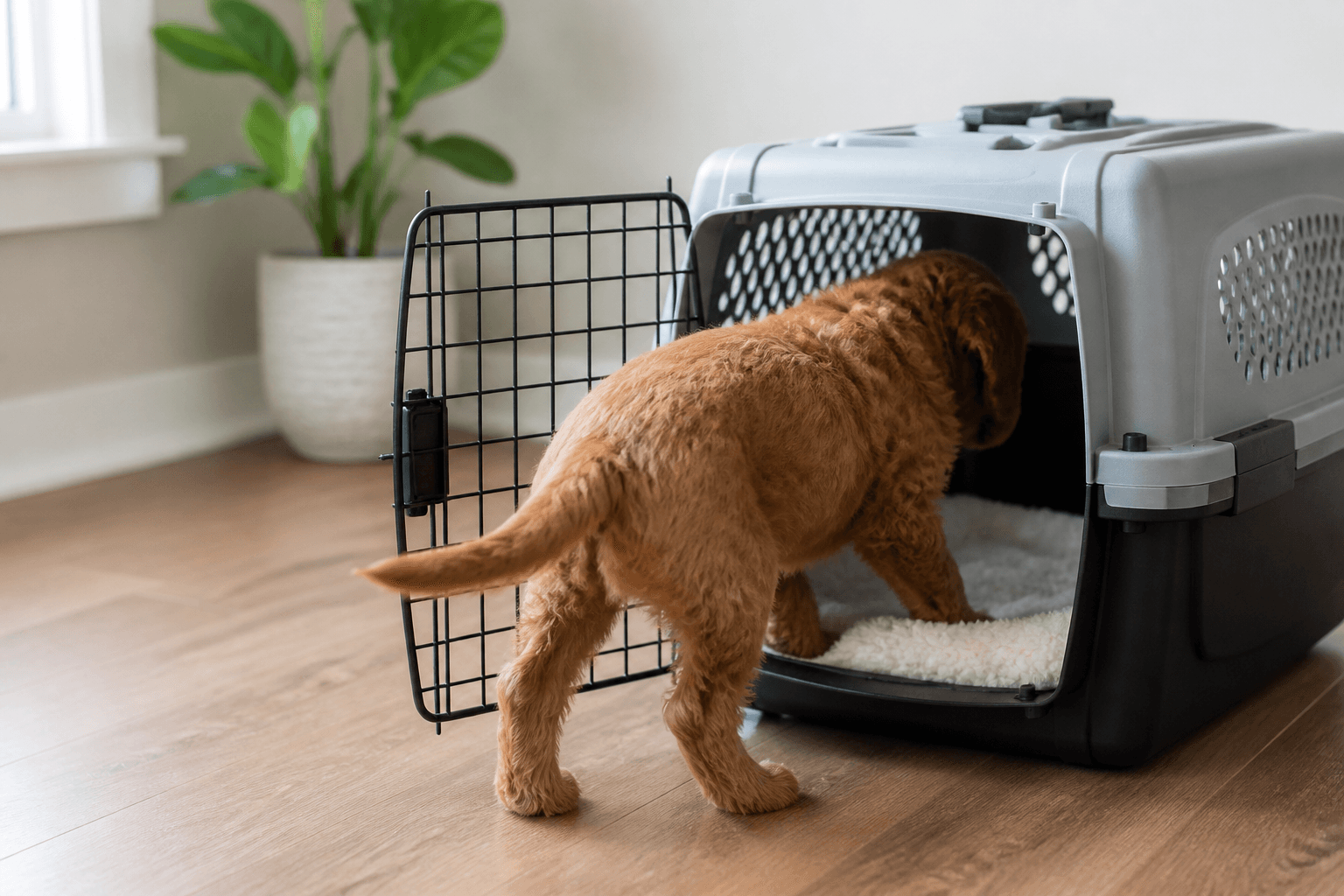
Filhote entrando voluntariamente em uma caixa de transporte aberta

Image credit: Acervo pessoal: DogWise

Puppies11 min readPublished on August 17, 2026

Puppy cries in the carrier: how to get used to it without forcing

The puppy enters the box, the door closes and the crying begins. The most common reaction is to choose between two extremes: opening immediately or letting him “cry until he gets tired”. None of them teaches, alone, that that space is safe. Adaptation usually works best when the box stops just predicting a separation, car or appointment and becomes part of small, predictable and pleasant experiences.

Crying is not defiance or manipulation. It can express fear, frustration, the need to urinate, heat, nausea, pain or simple difficulty staying away. The tutor needs to observe the context and adjust the exercise. The goal is not to achieve silence at any cost, but to build enough comfort so that the puppy travels protected without panicking.

Before training, get the box and environment right

The crate should allow the puppy to stand in a natural posture, walk around and lie down comfortably. Too large, may slide during transport; too small, restricts movement and ventilation. Check weight limit, locks, integrity and manufacturer's instructions. For travel, the way you secure the box to the vehicle also matters.

Choose a ventilated and resistant model, suitable for the species and use. Very flexible bags can give way to the animal; Open railings offer a wide view, but some puppies rest better with less visual stimulation. Do not improvise closure with parts that could catch nails, collar or jaw.

When training at home, place the box in a quiet area, but integrated into the house. An isolated corner from the first day can intensify insecurity. Leave the floor firm, without a high blanket if the puppy destroys fabric or feels hot. Remove collar, harness and pendants before leaving him inside without direct contact, as they may become tangled.

Find out what the crying is saying

Notice the body, not just the sound. A frustrated puppy may vocalize, look at its owner and even accept treats. When there is increasing fear, there may be a shrunken body, an intense attempt to escape, salivation, out-of-context panting, refusal of food, tremors and elimination. These responses indicate that the stage has advanced too far.

Check basic needs before training:

  • has he urinated and evacuated recently?
  • are you hungry or have you just eaten a large meal?
  • is the environment hot or stuffy?
  • Was there excessive play and is he irritable with tiredness?
  • is there physical discomfort, vomiting, diarrhea or pain?
  • does the box shake, make noise or have a strong odor?

Very young puppies have limited bladder control and should not be confined for periods incompatible with their age and routine. If the crying appears after a predictable interval and ends after a calm trip to the place of need, there is probably important information there.

An adaptation in really small steps

Don't wait for a scheduled trip to present the box. Do short sessions at quiet times and stop while the puppy is still well. Several easy experiments often teach more than one long session.

1. The box appears without requiring input

Leave the door stuck open so it doesn't slam. Sit nearby, spread some snacks around and allow exploration. Do not push the puppy or place it inside. If he avoids you until he approaches, reward looks and steps towards the crate. The first criterion might be just being close without tension.

2. Entering and leaving remains a choice

Place a snack at the entrance and then a little further down. Use part of the meal, if appropriate, to avoid excess. The puppy comes in, eats and leaves. Don't close the door in surprise. Repeat until he approaches voluntarily and maintains a relaxed posture.

A word like “box” can be said before he enters, but don't turn the command into pressure. Voluntary movement is more important than speed. If he stretches his body without putting his hind legs on, the step is still difficult; bring the reward closer.

3. The door moves for a moment

When he enters easily, touch the door, reward and open it completely. Then move it a few centimeters. Only then close it for a second and reopen it. Deliver the treat while the door is closed, not just after you leave. Thus, closure predicts something good.

Increase from one to two, three and a few seconds in different sessions. If the puppy stops eating, scratches or tries to escape, return to the point where he was comfortable. Backing down does not “ruin” the training; prevents fear from being rehearsed.

4. The tutor changes position

With the door closed for a short period, move your body, stand up and sit down, take a step and come back. Alternate distance and duration: if you move further away, reduce the time. Do not simultaneously increase closed door, distance, noise and duration.

Return before the cub reaches despair. This is different from opening at the exact moment of a frustrated bark. In an easy workout, wait for a brief natural pause to open up. In a panic, prioritize removing the animal calmly and reschedule a much simpler step; prolonging suffering does not teach self-regulation.

5. The box moves

Close the door, lift the box correctly and support it again. Then carry it a few steps indoors. Keep it level. Some puppies agree to stay inside, but they are scared by the swinging and the noise of the handle. Training this element separately avoids a surprise on the day of the trip.
From the room to the car without skipping steps

First, let the puppy explore the stopped and turned off car, always in safe conditions and at a comfortable temperature. In another session, attach the crate, reward and remove. Then run the engine for a short time without leaving it. Only then take a very short journey, preferably with an adult responsible for the puppy while someone else drives.

Never train in a closed car in hot weather, nor leave the animal alone. The internal temperature can rise quickly. The box must be secured in accordance with the safety guidelines applicable to the vehicle and equipment; When released, it moves under braking.

If your puppy drools, swallows repeatedly, vomits or becomes exhausted when moving, talk to your veterinarian. Motion sickness cannot be resolved just by offering snacks and can create an aversion to the car and the box. Do not give human medications or sedatives yourself.

Take some journeys that end in neutral or pleasant experiences, not just vaccinations and procedures. A short trip followed by a return home changes the forecast, as long as the puppy is comfortable.

Tutor oferecendo petisco ao filhote perto da porta da caixa
Image credit: Acervo pessoal: DogWise

How to respond to crying without reinforcing fear

The phrase “don’t open it when he cries” is simplistic. Before deciding, evaluate intensity, duration and probable cause. A brief grunt during easy exercise may allow for a few seconds to pause; then open it calmly. Increasing crying with signs of fear calls for immediate reduction in difficulty.

Don't talk incessantly, hit the box or shake it to correct. Your presence can be calm and predictable. Staying close, breathing normally and offering food through the opening, if it accepts, helps in the initial stages. Gradually reduce this help.

If every vocalization makes the door open instantly, the puppy can learn that vocalizing works. The solution is not to leave you in pain, but to set up exercises that are so easy that there are frequent breaks to reward you. It is also worth teaching short moments of safe separation outside the box.

Practice routine for seven sessions, not seven days

The pace depends on the animal. The sessions below can take place over more than one week or be repeated many times:

  1. Approach, receive reward and move away.
  2. Put on the front paws, eat and leave.
  3. Enter in one piece with the door open.
  4. Remain inside while receiving part of the meal.
  5. Close for a second, reward and open.
  6. Increase a few seconds and move your body.
  7. Get up, walk a few steps and then see the stopped car.

End each session with a normal activity, without excessive partying. Record how long he still eats and relaxes. In your next workout, start a little below that level, not exactly at the limit.

When common strategies fail

Use the box only to exit

If the box appears just before the car, the puppy learns this sequence. Keep her available in pleasant domestic moments, with the door open and supervision. Eventually, offer a safe item to chew or a meal there.

Attract with food and close quickly

This can work once and destroy trust the next time. The reward should not be bait for a trap. Prompt with predictable movements and build closure gradually.

Do training when he is “exhausted”

Moderate tiredness can facilitate rest, but exhaustion and overstimulation make puppies irritable. Intense physical activity is also not suitable for all ages. Prefer needs met, brief exploration and a time when he can learn.

Completely cover the box

A cover may reduce stimuli for some dogs, but compromise ventilation, increase heat or scare others. Test only with supervision, fabric out of reach and air circulation preserved. Notice the response instead of assuming that darkness always calms.

Increase time too quickly

Five quiet minutes does not guarantee a quiet half hour. Duration, distance from the tutor, movement and environment are different difficulties. Changing one variable at a time shows where the problem is.

Caixa de transporte presa com segurança no banco do carro
Image credit: Acervo pessoal: DogWise

Safety and responsible use

The transport crate is not a punishment or a place to keep the puppy for convenience for most of the day. He needs adequate sleep, interaction, age-appropriate movement, elimination opportunities, and safe exploration. Prolonged confinement can increase frustration and accidents.

Check the box before each trip: screws, latches, cracks, edges and ventilation. Tag it as needed. Take water and plan breaks on long trips according to veterinary advice, age and travel conditions.

The AKC maintains a care and training guidance section that can complement conversations with professionals. For other repetitive behaviors that appear during the rest period, see also why a dog may lick its paws at night.

When to ask for help

See your veterinarian if there is recurrent vomiting, diarrhea, pain, difficulty breathing, intense salivation, apathy or suspicion of nausea. For intense fear, escape attempts that cause injury or lack of progress despite small steps, seek a behavior professional who works with non-intimidating methods and in conjunction with the veterinarian.

Also ask for advice before air or long trips. Airlines and destinations may have specific rules, and the box used at home may not always meet the requirements. Preparing documents and equipment early avoids turning training into an emergency.

Frequently asked questions

Should I put the crying puppy to sleep in the crate?

Only if the adaptation is already compatible with this period and the elimination needs are met. Starting with an all-nighter can be a big leap. Keep the box nearby initially and plan calm exits for necessities.

Can I offer a toy inside the box?

Yes, if it is suitable for size, resistant and has already been observed under supervision. Remove items that fall apart, get stuck in teeth or are swallowed. Water and food during transport depend on duration and professional guidance.

How long does it take to get used to it?

There is no universal deadline. Some puppies advance in a few days; others need weeks. The best indicator is being able to eat, explore and rest without signs of fear, not sticking to a schedule.

What if he comes home but cries in the car?

Train movement, stationary car, engine sound and short journeys separately. Consider motion sickness and talk to your veterinarian if there is drooling, vomiting, or drooping.

Can the box always be left open at home?

It can, if it is stable, safe and in a suitable location. The door must be secured so that it does not slam, and the environment needs supervision compatible with the puppy's age.

Conclusion

Getting a puppy used to the crate means teaching a sequence of predictability: approach, enter, see the door move, stay for a moment, tolerate distance, feel movement and travel. When these steps are separated, the tutor can identify the difficult point without resorting to force.

Adjust size, ventilation and safety; meets physical needs; reward voluntary choices; Only increase one difficulty at a time. When faced with intense crying, step back and investigate, rather than waiting for the fear to disappear out of exhaustion. A really useful crate is not one in which the puppy has been left with no way out, but one in which he has gradually learned that he can remain protected.