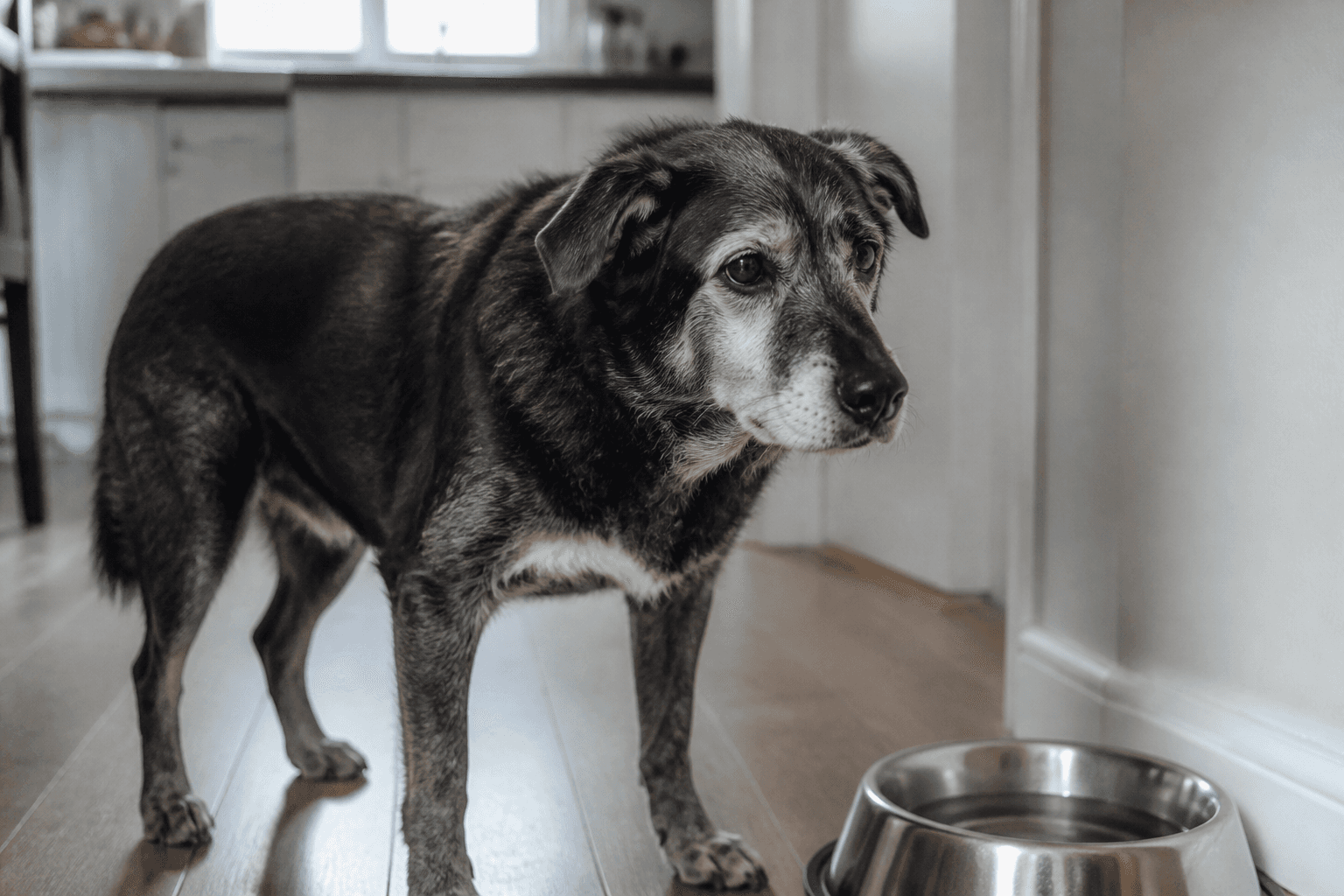
Cão idoso ao lado da tigela de água em cozinha iluminada, olhar distante

Image credit: Acervo pessoal: DogWise

Health8 min readPublished on August 31, 2026

Confused senior dog drinking more water: dementia or a health problem?

Your elderly dog ​​walks around the house as if lost. Stops in the middle of the corridor. Look in the corner. At night he doesn't sleep well. And at the same time, the water bowl empties faster.

The question that comes to mind: is it dementia… or is it a health problem?

The honest answer: it could be one, the other, or both together — and only examination + well-told history help to separate them. Confusion in an old dog does not prove dementia. Drinking more water does not prove “just age”. The two signs deserve attention, especially when they appear together.

This text is educational and does not replace evaluation, examinations or guidance from a veterinarian. If there is intense weakness, repeated vomiting, difficulty breathing, collapse or straining to urinate without being able to, seek care without waiting.
The direct answer

Canine cognitive dysfunction (many people call it “dog dementia”) is a real problem in the elderly and can change sleep, orientation and routine — including the way they use the house and bowl. But clearly greater thirst, especially with more pee or new accidents, is usually a classic medical sign: kidney, diabetes, hormonal problems, urinary infection, effects of medication, among other causes.

That's why the safest way is not to choose a label on the internet. It's organizing what has changed and taking it to the consultation. DogWise already has a sister text about elderly dog ​​that drinks too much water; here the focus is on the intersection of confusion + thirst.

Cornell University explains that cognitive dysfunction syndrome is common in elderly dogs, can be underdiagnosed (many owners think it is “normal for their age”) and that the veterinarian usually orders a physical examination, blood and urine to rule out other causes with similar signs.

The AVMA, in material about elderly pets, reinforces the same spirit: aging is not an illness — and check-ups help to find problems early.

What “dementia” often looks like at home

Veterinarians use the term cognitive dysfunction syndrome (CDS). At home, the tutor notices patterns such as:

  • get lost in familiar environments;
  • getting “stuck” in corners or behind furniture;
  • not recognizing people or routines as usual;
  • sleeping during the day and being restless at night;
  • interact less (or get too attached in a new way);
  • pee/feces accidents without seeming to notice;
  • barking or moaning for no clear reason at night.

This may be cognitive. It could also be pain, vision/hearing loss, anxiety, metabolic disease or medication effects. Isolated confusion does not close the diagnosis.

What the major headquarters usually indicates (and what not)

Drinking a little more in hot weather, after a walk or with drier food may be normal. The alert goes up when the change is clear and persistent: bowl empties more, he asks for water out of turn, wakes up at night to drink, or pee increases along with it.

Common medical causes in the elderly (educational, non-diagnostic list):

  • kidney disease;
  • diabetes mellitus;
  • Cushing's disease (excess cortisol);
  • urinary infection or inflammation;
  • liver problems;
  • medicines that increase thirst/pee (e.g. some corticosteroids or diuretics, when prescribed).

If thirst and urination have grown together, the article dog drinks a lot of water and pees a lot organizes what to observe on a daily basis — without replacing blood and urine tests.

Key Point: Dementia can change behavior around water (going back and forth to the bowl, forgetting where it is, drinking erratically). Now real polydipsia (drinking much more volume) calls for medical investigation. Don’t assume “it’s just the head”.

How to differentiate in practice (without inventing an exam)

You don't need to close the case at home. Need to separate tracks:

Signs that pull more towards the cognitive side

  • disorientation in familiar rooms;
  • inverted sleep-wake cycle;
  • looking “empty”, standing still without purpose;
  • forget simple commands you knew;
  • clear social change without fever, vomiting or explosive thirst.

Signs that lean more toward the medical side (thirst/illness)

  • clearly larger volume of water;
  • peeing more frequently or in greater volume;
  • new accidents with increased thirst;
  • weight loss, very high or very low appetite;
  • vomiting, diarrhea, weakness, different breath;
  • straining to urinate, blood in the urine.

Signs that confuse the two

  • nocturnal accidents (could be cognition, pain when moving, or excessive urination due to illness);
  • restlessness at night (pain, anxiety, CDS, need to urinate);
  • “not finding” the door or the bowl (vision, hearing, cognition).

If there is pain — hesitation, new posture, difficulty getting up — see also how to know if your dog is in pain. Chronic pain in the elderly masks and imitates many things.

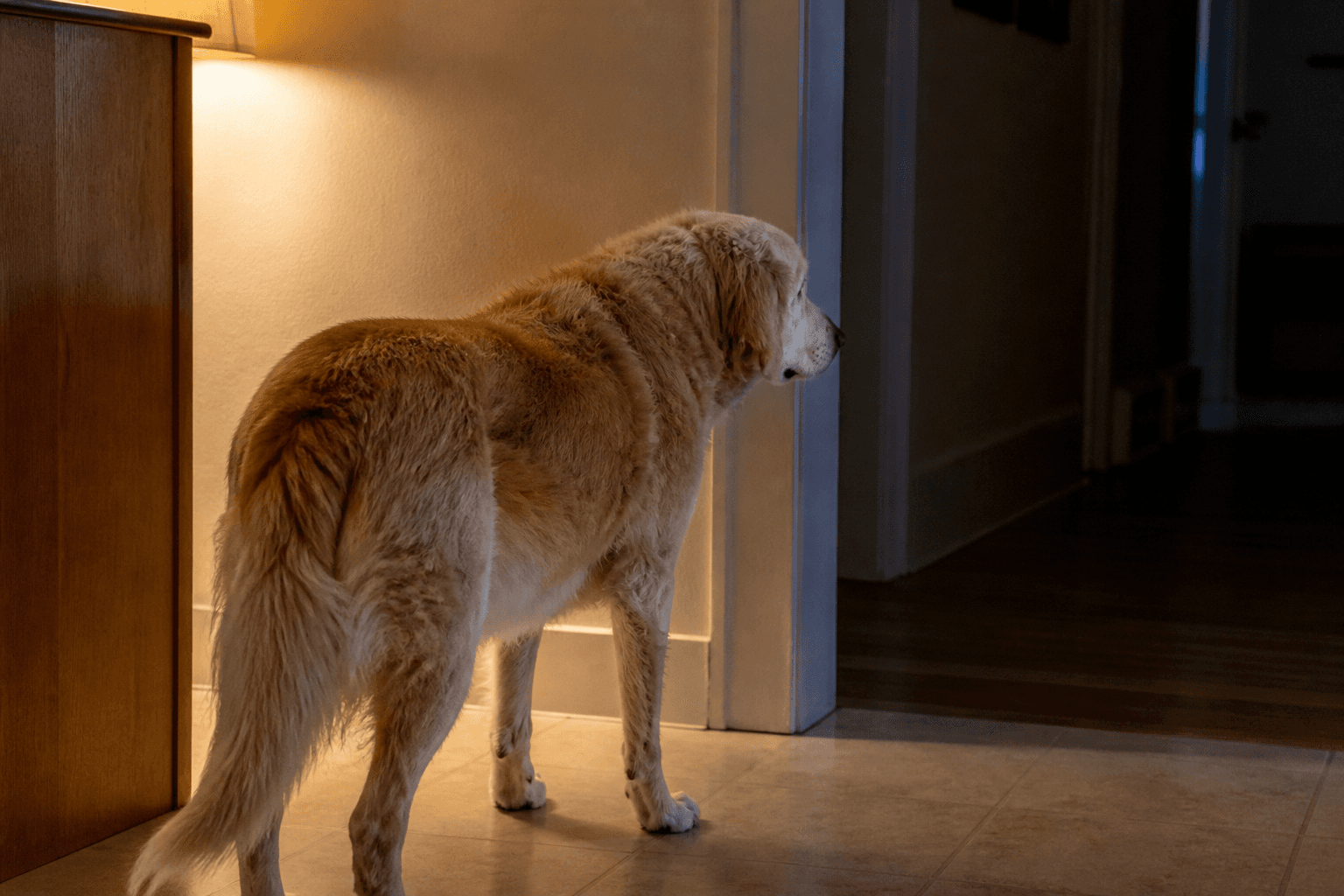
Cão idoso parado no corredor à noite com expressão confusa
Image credit: Acervo pessoal: DogWise

What to write down before the consultation (useful checklist)

In 2–3 days, if the dog is stable:

  1. Water: how many times do you fill the bowl? How long have you noticed the increase?
  2. Pee: more often? bigger volume? accidents? effort?
  3. Confusion: at what time? in which rooms? 10–20 second video helps.
  4. Sleep: Do you sleep during the day and wander around at night?
  5. Appetite and weight: Do you eat more, less, or the same amount? lost weight?
  6. Medicines and supplements: complete list, with dose.
  7. Vision/hearing: respond to the call? bump into furniture?

Take concrete phrases: “he has been emptying his bowl twice a day for two weeks”, “standing in the hallway at night”, “peeing in the living room three times this week”.

What the veterinarian usually evaluates

In elderly people with confusion and/or thirst, the consultation generally combines:

  • complete physical examination;
  • detailed history (behavior + thirst/pee);
  • blood and urine tests (very common in this scenario);
  • assessment of pain, vision, hearing and mobility;
  • discussion whether behavioral signs fit into CDS after ruling out treatable medical causes.

Cognitive dysfunction, when considered, is usually a diagnosis of exclusion: first, what is treatable and measurable is investigated. Don’t expect (or ask for) a “one-time dementia exam” on your cell phone.

What to do at home while you wait (without medicating yourself)

  • Keep water always available — don’t restrict it because you think you “drink too much”.
  • Make access to the bowl and pee area easier (soft night light, non-slip mat).
  • Stable routine: walking, eating and resting times.
  • Avoid sudden changes of furniture if he is already disoriented.
  • Do not give human medicine to “calm down” or “hold back pee”.
  • Do not punish accidents: this worsens fear and does not treat the cause.

These measures improve comfort. Do not replace diagnosis.

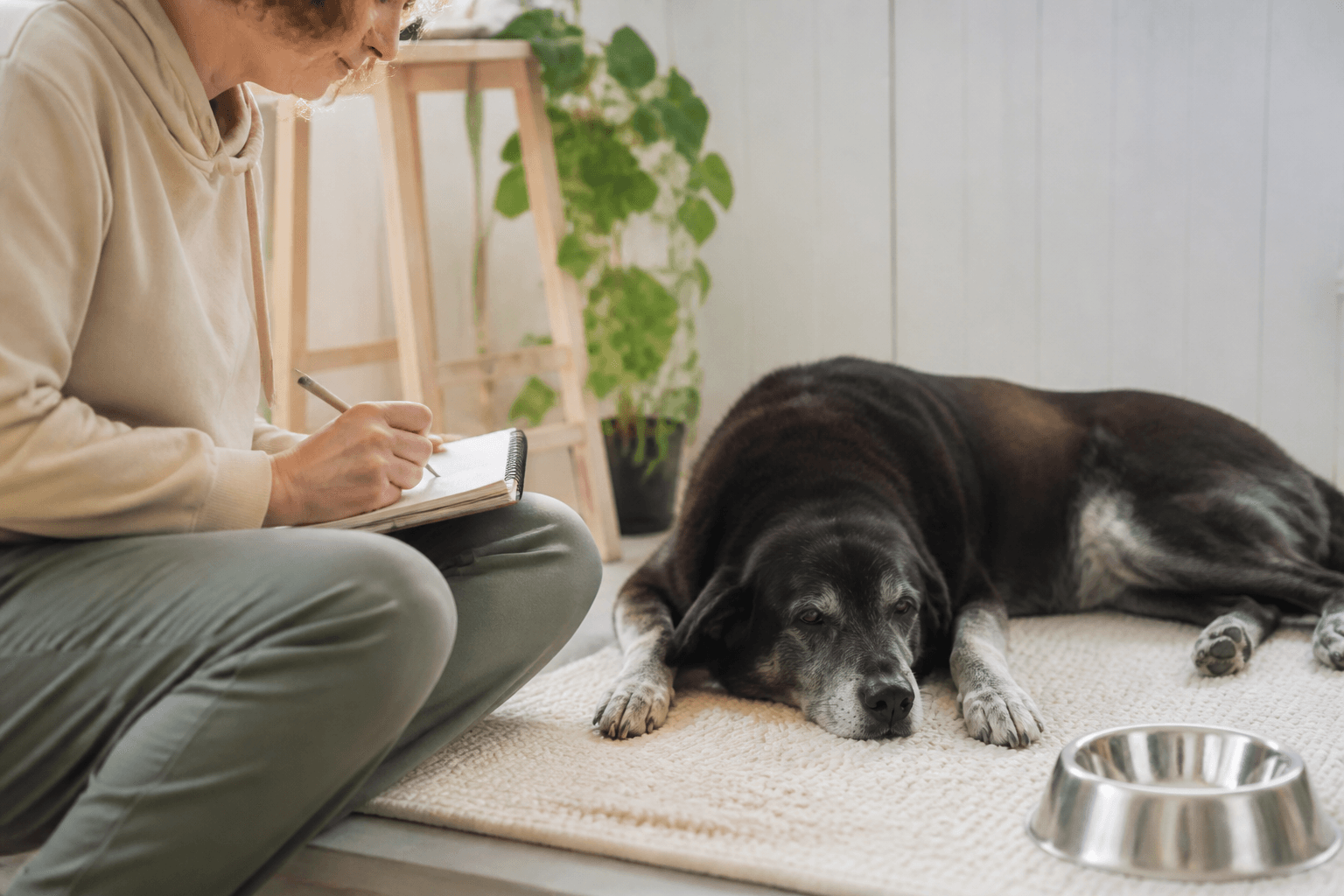
Tutor anotando observações enquanto cão idoso descansa perto da água
Image credit: Acervo pessoal: DogWise

When to book — and when it’s urgent

Book within a short period of time if:

  • thirst has clearly risen;
  • the confusion is new or worsening;
  • there are new accidents + more water;
  • the dog “has not been the same” for days or weeks.

Anticipate / urgency if you notice:

  • weakness, tremors, fainting;
  • repeated vomiting or complete refusal of food;
  • difficulty breathing;
  • intense effort to urinate with little or no pee;
  • sudden and intense disorientation;
  • very pale or bluish gums;
  • hard or very painful abdomen.

When in doubt between “next week” and “today”, choose the path that protects the animal.

Common mistakes of the well-intentioned tutor

  1. “It’s just old age.” Age increases risk; does not authorize ignoring.
  2. Treat only the behavior and ignore the thirst. Too much thirst requires examination.
  3. Restrict water. Dehydration can worsen if there is illness.
  4. Compare with the neighbor's dog. Compare with his standard.
  5. Wait for dementia to “prove” itself. The sooner the evaluation, the more management options.

Frequently asked questions

Is Confused Elderly Dog Always Dementia?

No. Pain, sensory loss, anxiety, infection and metabolic disease can mimic. That’s why professional assessment matters.

Is drinking more water a symptom of dementia?

There may be a change in habits around the bowl. A clear increase in volume, especially with more pee, usually points to a medical cause that needs to be investigated.

Can I wait and see if it gets better on its own?

If the change is discrete and short, write it down and observe it in a short period of time. If thirst or confusion are evident, do not wait longer — some causes worsen in silence.

Does an accident at home prove dementia?

Not alone. It could be too much urine due to illness, pain getting to the door, loss of control or yes CDS. The set of signs + exams provides guidance.

Can dementia and kidney disease exist together?

Yes. Elderly people accumulate problems. Treating anything that is clinical does not “cancel” cognitive care — and the opposite is also true.

What to take to your first appointment?

Videos of disorientation, water/pee estimation, medication list, food changes and what made things worse or better. The more concrete, the better the starting point.

Conclusion

Elderly dog confused and drinking more water is not a verdict of dementia on the tip of your tongue. It's a combo that calls for method: observing behavior, measuring real thirst, recording pee and sleep, and taking facts to the clinic.

Don’t restrict water, don’t take medication on your own and don’t normalize everything as “age”. Organize the history, schedule an evaluation and treat whatever is treatable early. Taking good care, at this stage, means changing the label for investigation — with care and with data.